Open-Source Modeling Framework
Flow and Transport in Karst Systems
openKARST simulates flow and transport in complex karst conduit networks using the full Saint Venant equations. It handles mixed free-surface and pressurized flow, complex conduit geometries, transient and steady-state behavior, and friction laws including Darcy–Weisbach (using the Churchill friction factor correlation) and Manning. Ongoing development extends the framework toward coupling with porous media and catchment-scale hydrological processes.
Model Capabilities
openKARST provides a flexible framework for simulating flow and transport in complex karst conduit networks. While currently focused on conduit-dominated systems, the model is actively being extended toward broader hydrogeological applications, including recharge-driven forcing and more complex conduit–matrix exchange processes.
Hydrodynamic Flow Solver & Simulation
Solute Transport & Particle Tracking
Flexible Conduit & Network Geometry
Friction & Hydraulic Formulations
Visualization, Dashboards & Data Export
Hydrogeological Coupling (In Development)
Example Simulations
openKARST supports a variety of flow and transport scenarios, including transient pulse injections, solute transport, and simulations using real or synthetic conduit geometries. The examples below illustrate typical applications.
Transient Flow in Large 3D Karst Networks
openKARST supports stationary and transient simulations in large karst conduit networks, resolving flow propagation, network-scale connectivity, pressurization dynamics, and delayed system responses across highly interconnected geometries.
Free-Surface and Pressurized Flow
openKARST resolves transitions between free-surface and pressurized flow using the full Saint Venant equations. This allows simulation of wetting and drying fronts, rapid inflow events, and pressurization in partially flooded conduits, supporting realistic modeling of transient karst responses.
Advection-Dispersion Transport
openKARST includes an implementation of the 1D advection–dispersion equation for solute transport in conduit networks. This enables simulation of breakthrough behavior, dispersion effects, and early/late tailing phenomena in complex network structures.
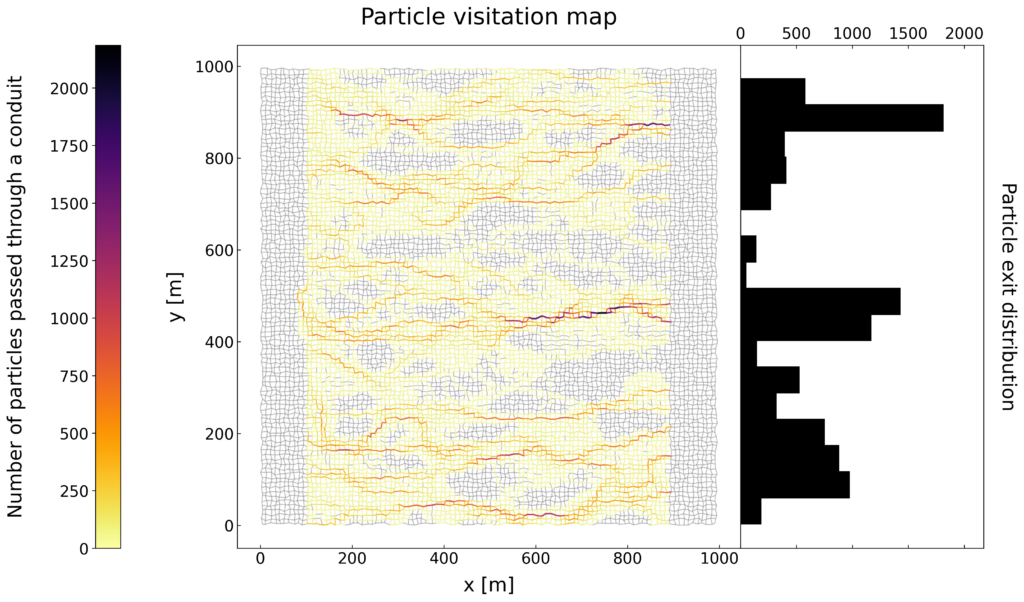
Particle Tracking & Transport Pathways
openKARST provides particle-tracking capabilities for analyzing flow paths, travel-time distributions, and preferential transport in complex conduit networks. This enables assessment of connectivity, flow partitioning, and system-scale transport behavior.
About the Project
openKARST is an open-source framework for simulating flow and transport in karst conduit networks. The model is developed within the European Research Council project KARST: Predicting flow and transport in complex karst systems, which aims to advance our ability to model extreme events, network-scale processes, and multi-scale hydrodynamic behavior in karst aquifers.
The KARST project addresses fundamental challenges in understanding flow and transport in complex subsurface environments, including conduit-scale dynamics, catchment-scale network structures, and the development of new upscaled modeling approaches. More information is available on the ERC KARST project website.
Publications
Journal Articles
Kordilla, J., Dentz, M., Hidalgo, J. (2026)
openKARST: A novel open-source flow simulator for karst systems
Computers & Geosciences, 106066
https://doi.org/10.1016/j.cageo.2025.106066
Conference Contributions
Huang, J., Kordilla, J., Dentz, M., Barry, J., Langevin, C., Kang, P. (2026)
A field-inspired, systematic investigation of conduit network impacts on flow and transport in karst aquifers
Sinkhole Conference 2026
Dufour, D., Renard, P., Kordilla, J., Straubhaar, J. (2026)
Karst network geometry and groundwater flow in the Aup du Seuil catchment (Chartreuse, France)
EGU General Assembly 2026
Kordilla, J., Dentz, M., Hidalgo, J. (2026)
openKARST: From detailed karst conduit dynamics to simplified hydraulic flow dynamics
EGU General Assembly 2026
Roche, P., Kordilla, J., Gabrovšek, F., Straubhaar, J., Renard, P. (2026)
Physics-based modeling of speleogenesis in openKARST: Preliminary results
Karst School 2026
Peyrière, H., Cousquer, Y., Boura, A., Kordilla, J., Sivelle, V., Batiot-Guilhe, C. (2026)
Coupling stochastic conduit generation with flow and transport models to assess observational constraints on karst conduit inverse problems
Eurokarst 2026
Kordilla, J., Hidalgo, J., Dentz, M. (2026)
Simulación de sistemas kársticos utilizando openKARST
CIAS 2026
Kordilla, J., Dentz, M., Hidalgo, J. (2025)
openKARST: Assessing flooding dynamics in karst aquifers with a resolution-aware modeling tool
Geo4Life 2025
Kordilla, J., Dentz, M., Hidalgo, J. (2025)
openKARST: A novel computational modeling tool for flow and transport in complex karst conduit networks
EGU General Assembly 2025
Kordilla, J., Dentz, M., Hidalgo, J. (2024)
Hydraulic and geometric controls on flow and transport dynamics in complex karst networks: A novel computational modeling tool
IAH World Groundwater Congress 2024
Get Started with openKARST
Whether you’re new to karst modeling or integrating openKARST into research workflows, the documentation and GitHub repository provide everything you need to begin. For feedback, questions, or potential collaborations, you can always reach out.